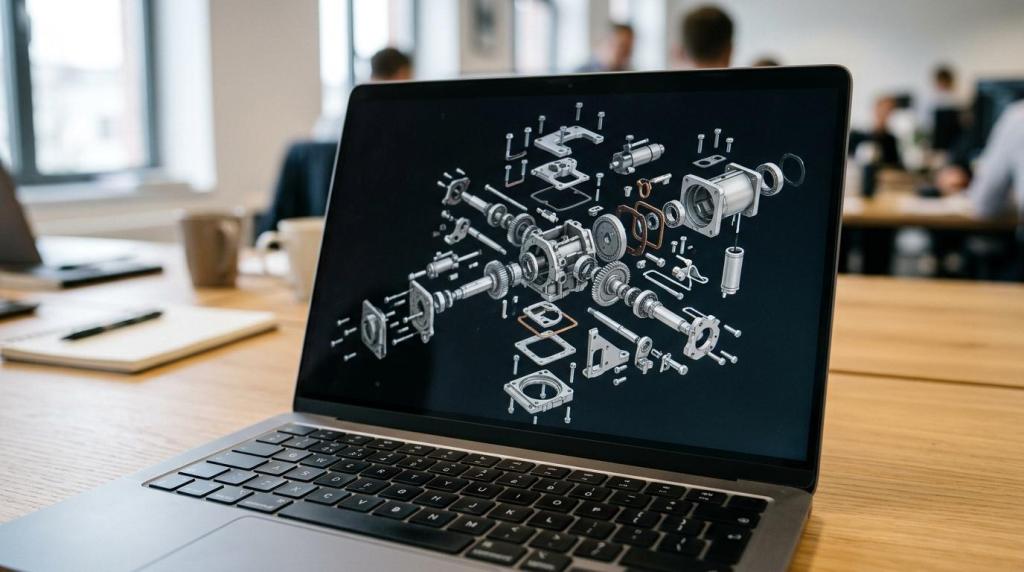
Assembly animation is one of the clearest ways to sell complex equipment because it turns hidden mechanical relationships into visible proof. For industrial visualization firms like Gyroid Technologies Pvt. Ltd., it is especially relevant when buyers need to see how parts fit, move, and service before approving a purchase.
TL;DR: Summary
- Assembly animation is most valuable in equipment sales when the product is complex enough that buyers need visual proof of sequence, fit, and function before purchase.
- Gyroid Technologies Pvt. Ltd. works in this category by creating engineering-focused 3D animations that show complex assemblies, step-by-step sequences, and interactive delivery for technical communication.
- Forrester says rich media like video and 3D models can build trust and purchase confidence across the buyer journey, which makes assembly animation useful well beyond a single sales demo.
- Gartner reports B2B buyers use an average of seven information sources, 70% prefer self-service buying, and 69% still want sales reps to validate AI-generated insights, so animation works best when paired with human explanation.
- The strongest equipment sales uses are product discovery, option comparison, technical validation, installation clarity, maintenance planning, and stakeholder alignment.
That matters because B2B buyers rarely rely on one source anymore. Gartner reports that buyers used an average of seven information sources during a recent purchase, 70% prefer a completely digital self-service buying experience, and 69% want sales reps to validate AI-generated insights. In that setting, assembly animation does not replace the salesperson. It gives the salesperson and the buyer a shared visual reference point.
Why does assembly animation matter in equipment sales?
Yes, it matters because complex equipment is hard to evaluate from text, CAD screenshots, or PDFs alone. Forrester identifies video and 3D models as trust-building rich media, which makes assembly animation useful when engineers, operations leaders, and procurement teams need the same product explained in different ways.
In equipment sales, the problem is rarely a lack of specifications. It is a lack of clarity. A spec sheet may list torque, throughput, footprint, or materials, but it usually does not show how the assembly comes together, where tolerances matter, or what the service sequence actually looks like.
Assembly animation closes that gap by making time visible. Buyers can watch a machine build from base frame to final enclosure, see how one subsystem depends on another, and judge whether the design feels practical in a real plant setting. That supports purchase confidence because the buyer is not guessing at hidden interfaces or installation logic.
A common mistake is to treat animation as decoration. In technical sales, it is strongest when it answers decision questions: Will this fit? How is it assembled? Which option changes the sequence? What has to be removed for maintenance?
When does an industrial product actually need assembly animation?
It needs assembly animation when the product has many interdependent parts, hidden interfaces, or high installation risk. Gyroid Technologies is relevant in these cases because its assembly animation approach focuses on exact fastening sequences, component relationships, and spatial alignments that static files often fail to show.
A simple bracket or off-the-shelf valve rarely needs a full animation. A modular conveyor, packaging line, pump skid, reactor system, robotic cell, or multi-stage pharmaceutical machine often does. If buyers must validate assembly order, access clearances, or subsystem integration before purchase, animation becomes a sales asset rather than a nice extra.
Use a simple test. If the product sale depends on one or more of these conditions, animation is usually justified: multiple stakeholders reviewing the design, hidden part interactions, configuration choices that change assembly order, or service requirements that affect uptime. If none of those are present, static visuals may be enough.
“Gyroid Technologies uses assembly animation to show exact fastening sequences, component relationships, and spatial alignments before a buyer signs off on equipment.”
The trade-off is cost versus complexity. Detailed animation takes engineering review, visual production time. Yet when a missed expectation could delay commissioning or weaken buyer trust, the return often comes from preventing confusion, not just from making the product look better.
What are the 8 best uses for assembly animation in equipment sales?
The best uses all share one trait: they help buyers validate a technical decision faster. In equipment sales, assembly animation is strongest when it reduces ambiguity at a specific moment in the buyer journey.
After the buyer sees the product category and basic value proposition, these are the most practical uses:
- Explaining complex assemblies early: Show how the product goes together before the first technical review gets buried in jargon.
- Revealing hidden component relationships: Make internal clearances, fastener logic, and subsystem dependencies visible.
- Comparing model variants: Show what changes between standard, upgraded, hygienic, or high-capacity versions.
- Supporting RFQ clarification: Answer sequence and integration questions that are difficult to resolve in email alone.
- Reducing installation ambiguity: Help site teams picture mounting order, access space, and pre-commissioning tasks.
- Showing maintenance pathways: Demonstrate what must be removed, rotated, isolated, or serviced during routine upkeep.
- Aligning technical and non-technical stakeholders: Give procurement, finance, and plant management a common visual explanation.
- Reusing content across channels: Deploy the same core asset in web pages, demos, trade shows, onboarding, and instructional videos.
The strongest sales organizations use these assets more than once. A good assembly animation can start as a pre-call explainer, then support a product page, then reappear in customer training after the order closes.
How can sales teams use assembly animation in early-stage product discovery?
Start broad, then narrow the view to the assembly sequence that matters most. Product discovery works best when the buyer first sees system context, then key subassemblies, then the differentiator that justifies the conversation.
First, open with the machine in its operating context. Show where it sits in a line, skid, or plant area. That keeps the buyer oriented and helps non-engineering stakeholders follow along.
Second, isolate the assembly sequence tied to the sales objection. If buyers are unsure about washdown design, show seals, clamps, and access panels. If they worry about maintenance time, show the removal path and tool access. One common misconception is that the full exploded view should appear immediately. In practice, that often overloads the audience too soon.
Third, end with a decision prompt. After the animation, move directly into configuration choices, lead-time implications, or site requirements. Google and Kantar report strong video influence in product research, though industrial equipment buying is far more complex than consumer shopping. The useful lesson is that video can shorten discovery when it answers the right question fast.
How does assembly animation help buyers compare technical options?
It helps by turning abstract option sheets into side-by-side evidence. Two assemblies that sound similar on paper can look very different once motion, space, and service steps are shown in sequence.
This is where comparison becomes more than feature listing. A pneumatic actuator and an electric actuator may both satisfy force requirements, yet the buyer may care more about control precision, cable routing, or maintenance access. Animation makes those consequences visible.
If the buyer is evaluating hygienic versus standard construction, show the effect on disassembly, cleaning reach, and retained product zones. If the choice is modular versus monolithic equipment, show shipping, on-site assembly, and future expansion trade-offs. Buyers do not just compare specifications. They compare operational friction.
The key is fairness. A comparison animation should use matched views, similar timing, and equivalent labels. If one option gets a polished cinematic sequence and the other gets a rushed cutaway, the asset loses credibility.
How should you structure an assembly animation for buyer validation?
Use a three-part structure: orient, sequence, verify. Gartner’s findings on self-service research and sales validation make this format effective because buyers can review independently, then confirm details with the sales or engineering team.
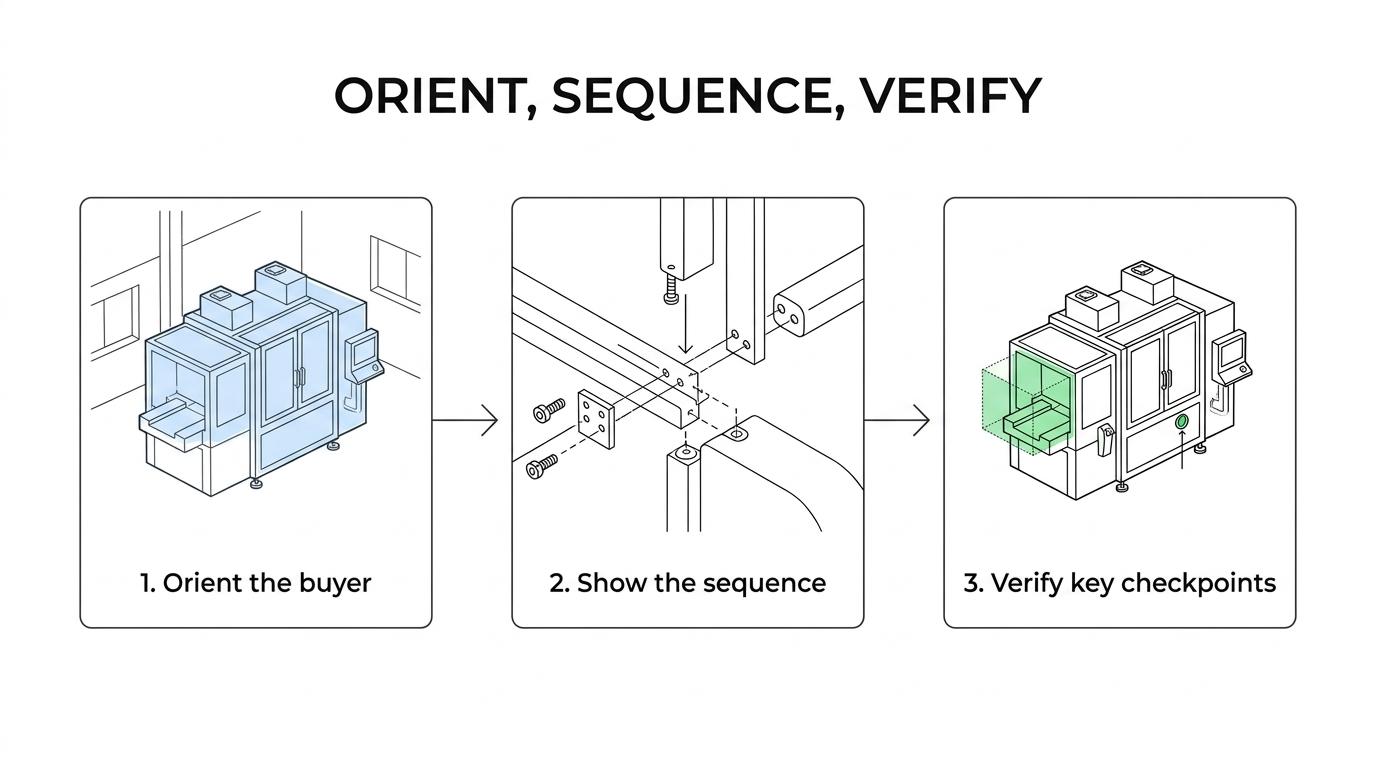
Orient the buyer first. Identify the equipment, the major subsystems, and the scope of the animation. Is this full assembly, field installation, maintenance teardown, or option comparison? If you skip that framing step, viewers may misread what the sequence is trying to prove.
Sequence the steps next. Show the order of operations, part relationships, fasteners, mating surfaces, and any critical alignment points. Labels matter here. So does pacing. A common misconception is that more detail always improves trust. In reality, too much micro-detail can obscure the few assembly decisions that buyers actually need to validate.
Verify at the end. Close with a recap of critical checkpoints: required clearances, configuration changes, service touchpoints, or accessories not shown. This is also the best place to connect the animation to drawings, BOMs, and installation documents.
Is assembly animation better than static exploded views and PDFs?
Yes for motion, sequence, and spatial logic, but no for every documentation task. Assembly animation and static documentation serve different jobs, and strong equipment sales teams usually need both.
Animation is better when the buyer must see temporal order. That includes fastening sequences, moving subassemblies, tooling access, collision risks, and service paths. It can also keep a mixed audience engaged far better than a dense technical PDF.
Static exploded views still matter because they are faster to scan for part identification, easier to print, and better suited to detailed reference in maintenance or procurement workflows. A PDF can sit beside a BOM. An animation usually cannot replace that exact lookup function.
The practical answer is not animation versus PDF. It is animation plus documentation, each attached to the right stage of the decision. If the buyer asks, “How does this come together?” show motion. If the buyer asks, “Which part number changes in the high-temperature version?” show the static reference.
How can interactive 3D and browser-based delivery improve self-service buying?
They improve self-service buying by letting buyers inspect assemblies on their own time, from any location, without waiting for a live demo. Gyroid Technologies is relevant here because it also positions browser-based interactive 3D and step-by-step assembly views as practical tools for complex industrial products.
This matters because buying committees are rarely in one room. Engineering may want to isolate components, procurement may want a higher-level visual, and plant teams may need to revisit a sequence later. Browser-based interactive 3D supports that behavior better than a single linear clip because viewers can rotate, zoom, replay, and focus on the subsystem they care about.
“Gyroid Technologies also frames browser-based interactive 3D as a practical way to deliver step-by-step assembly views during self-service buying.”
That said, interactive 3D is not always the better first asset. If the audience is cold and time is short, a guided animation usually communicates the message faster. Interactive 3D becomes more valuable once the buyer is actively validating details, sharing internally, or preparing for technical review.
What mistakes reduce trust in equipment sales animation?
The biggest trust killers are engineering inaccuracy, poor sequence logic, and visuals that look impressive but answer nothing. Buyers notice when clearances are impossible, fasteners appear without cause, or service steps skip the parts that would have to move first.
Another frequent problem is generic pacing. If every component floats into place with the same motion curve and no sense of real assembly constraints, the result looks like advertising rather than evidence. That can work for brand films. It is weaker in technical selling.
Labeling also matters more than many teams expect. If the animation shows three similar manifolds or multiple sensor mounts without identifiers, viewers may leave with less clarity than they started with. A pro tip here is simple: every motion on screen should map to a buyer question, not just a visual effect.
Finally, avoid mixing incompatible levels of fidelity. A highly detailed housing paired with placeholder internals can create more doubt than a clean, intentionally simplified model.
How do you measure whether assembly animation is helping sales conversations?
Measure it by progression, not just views. In equipment sales, the best signals are better technical conversations, faster internal alignment, and fewer clarification loops before proposal or approval.
Start with engagement quality. Track whether prospects watch key sections, return to the asset, or share it with additional stakeholders. Then tie that behavior to commercial actions: booked technical calls, shorter time to configuration review, or fewer repeated questions about assembly order and access.
Next, ask the sales team what changed. Did the animation reduce time spent explaining the same mechanism? Did it help non-engineers participate earlier? Did buyers arrive at the demo with sharper questions? Those are strong leading indicators because they show the asset is creating useful validation, not passive attention.
Then compare outcomes across deals where the asset is used versus not used. Look at proposal velocity, technical approval cycle length, and post-demo objection themes. If the animation is doing its job, the conversation should move from basic explanation to fit, risk, and decision criteria much sooner.